
Editorial · Gold ownership without the sales pitch
Most Gold Buyers Don't Know What They Own
There is a peculiar information problem at the heart of physical gold investing. It is one of the oldest asset classes in the world, held by central banks, sovereign wealth funds, and private individuals for centuries — and yet the primary channel through which most retail investors learn about it is a category of provider with an obvious financial interest in the transaction.
This is not an accusation. It is a structural observation. Gold dealers, IRA custodians who specialize in precious metals, and the media companies that produce gold-adjacent content all earn their living when you buy gold. Their incentive is to make you want gold, not necessarily to help you think carefully about whether you're buying the right type, from the right counterparty, in the right structure, at a price that reflects fair value.
The consequence is that a meaningful number of gold investors hold gold in forms they don't fully understand, through structures that expose them to risks they weren't told about, at prices they didn't know how to evaluate.
The most common example: the distinction between allocated and unallocated storage. Unallocated gold — where your holding is a claim against a pool, not a specific set of bars — means you are an unsecured creditor of the custodian. If the custodian fails, you have a general claim on their estate, not a claim on specific metal. Allocated gold, by contrast, means specific bars are segregated, titled in your name, and outside the custodian's balance sheet in the event of insolvency. The spread between unallocated and allocated fees is usually modest. The difference in the risk profile is not modest at all.
What the Data Says About Gold as a Portfolio Holding
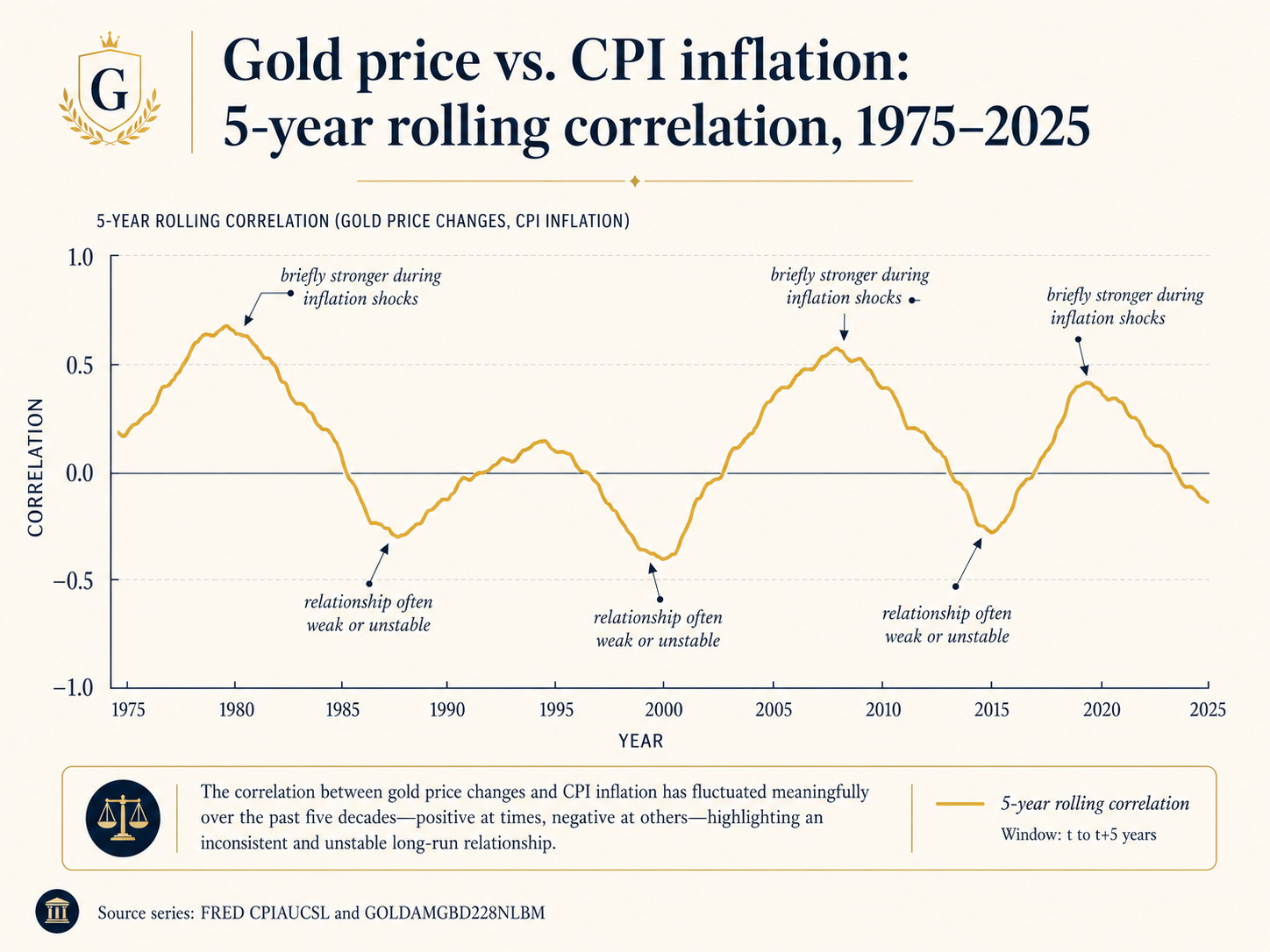
The analytical case for holding gold is more nuanced than either its advocates or sceptics typically present. Claude Erb and Campbell Harvey, in a widely-cited 2013 study in the Financial Analysts Journal, examined gold's historical role as an inflation hedge and found the relationship far weaker over shorter time horizons than widely assumed. Over any given five-year period, the correlation between gold prices and inflation was close to zero. Over very long periods — think decades — it was positive and meaningful.
Their finding isn't that gold doesn't protect against inflation. It's that the protection mechanism is slow and that investors who buy gold expecting short-term inflation coverage are holding the right instrument for the wrong reasons and on the wrong timeline. This distinction matters enormously for position sizing and for how you think about the holding during extended periods of real-terms underperformance.
"Over any given five-year period, the correlation between gold prices and inflation is close to zero. The protection mechanism is real — but it operates over decades, not quarters." — Claude Erb & Campbell Harvey, Financial Analysts Journal, 2013
The parallel with previous periods of monetary policy stress is instructive but often misread. Gold's extraordinary performance in the 1970s is regularly cited as the canonical inflation hedge case study. What's less discussed is that investors who bought at gold's early 1980s peak waited until 2008 to break even in nominal terms — over two decades. That isn't an argument against owning gold. It is an argument for treating it as a multi-decade strategic holding sized proportionately to your conviction, rather than a speculative vehicle timed to macro narratives.
Ron Stoeferle and Mark Valek of Incrementum AG, whose annual In Gold We Trust report has become a reference document for institutional gold analysis, have repeatedly made the point that gold's volatility relative to its long-term return profile suggests it functions best as a portfolio stabiliser at 5–15% allocation — meaningful enough to matter in a crisis, small enough not to damage compounding in the years when equities outperform substantially.
If you want to understand the full mechanics of buying physical gold intelligently — including dealer spread evaluation, allocated versus unallocated storage structures, IRA custodian due diligence, and how to size the position in a diversified portfolio — download the complete Physical Gold Investor Kit here. It's a 142-page independent guide written without dealer sponsorship or custodian affiliation.
The due diligence process for buying physical gold competently is not difficult — but it is specific. Understanding the spot price and how premiums are calculated. Knowing what a reasonable spread looks like and what questions to ask if you're quoted something outside that range. Understanding the difference between a gold-backed ETF, a pooled account, and fully allocated vaulted metal. These are learnable in an afternoon. The cost of not learning them — in terms of overpaying, misunderstanding what you own, or holding in the wrong structure — is real.
The honest conclusion is that gold deserves a place in most diversified portfolios — as a long-duration, low-correlation asset that tends to hold value through periods when conventional financial assets experience correlated drawdowns. The question isn't whether gold. It's how much, what form, and through what structure. Those questions have specific, answerable answers that have nothing to do with fear and everything to do with thoughtful portfolio construction.